
Monthly Archives: July 2018

Education in the Early Church

The early church provides a unique look at the development of a system of religious education fairly recently in history. With the death of the apostles, believers who were still alive had to face the reality of two major problems.

  1. What do we do with our children in terms of their education?
  2. How do we educate people who want to join the church?

The answers to these two questions intersect in many ways. This post will examine education in the early church.

Education of Children

The education of children was a problem for the early church. Children needed an education but state-run schools were not really an option. The reason has to do with the difference in philosophy of Christian education and state education.

Christian education is focused on character development and being prepared for eternity. In contrast, state education is focused on skill development and the here and now as eternity is often not a concern. As a result of this, Christians did not consider state-controlled schools as an option for their children.

In addition, it was common for state-led schools to mix Roman worship with education and for the Christians this was unacceptable. It is also important to realize that Christians were frequently persecuted as atheists during this time so it was impossible to go to school when one’s life was in danger.

The solution to this was the one that the Jews used, which was homeschooling. The focus of the child’s training was to develop a trust in the Christian God. By keeping the child at home he or she was protected from the influence of the world for a time. This led to a simplicity of taste that non-Christians found bewildering.

The Bible was the sole book for most children. The stories within it served as nursery tales. Scripture was memorized and the Bible was even used for learning to read.

With the focus on character development and a sense of morals, Christian education was vastly different from the education of other societies. Even without the focus on the classics and even technical training Christians were a spectacle to the world at this time. In terms of the results of this education among women one heathen author exclaimed “What wives these Christians have” indicating his awe in how these people conducted themselves.

Catechetical Schools

As the church grew, it became difficult to address the needs of new members. In particular, there were concerns over how to prepare prospective members for church membership. One answer to this problem was the development of Catechetical schools which were a place for prospective and current members to receive training in Christian beliefs.

For people considering baptism, the training could last anywhere from a few months to as long as three years. The curriculum consisted of learning the Ten Commandments, Lord’ Prayer, other parts of scripture, and as well as a confession of faith.

For people who were already Christian, they could receive advanced training that would prepare them for ministerial work as a teacher or leader. Some of the subjects covered for believers included philology, rhetoric, math, and philosophy.

The most prominent of these schools was found in Alexandria, Egypt. For several centuries after this,  Alexandria has a powerful influence on the Christian church.

Conclusion

The purpose of education is to meet the needs of the people in the context in which it is needed. The Early Christian Church had the dilemma of having to be separate from the world while still developing skills needed to survive in it. This led to the development of the homeschool for children and the Catechetical School for new converts.

Intro to Python

Python is a highly popular programming language. It is so popular that it is now the most commonly used programming language for machine learning/data science purposes having surpassed R.

However, Python is not limited to just statistical tools. Python is also used by many companies for a host of reasons including Yahoo, Dropbox,  Google, NASA, IBM, and Mozilla.

One secret to Pythons popular is its flexibility. When using Python it is possible to employ several different coding styles. Below is just some of them.

  • Procedural: This is the simplest form of coding and involves executing each line of code sequential.
  • Functional: Functions are used to transform data as found in mathematics.
  • Imperative: Employs statements to achieve a goal
  • Object-oriented: The use of objects (aka data structures) to model the real world. Not fully implemented in Python.

You can mix these styles together to make powerful applications.

Using Python

You can download Python by searching for “Anaconda Python” in Google. The Anaconda version of Python downloads several additional features to besides Python including the Spyder IDE which is what we will use here.

Once you download and install Anaconda, on your computer you need to search for the program called “SPyder”. When you open it you will see the following.

1.png

Here is what each pane represents.

  • To the left is the text editor, you can type code that you want to save here.
  • In the top right is the variable explorer. Here you can find a list of the objects you have made.
  • In the bottom right is the Interactive Python console or “IPython” console for short. Here you can type code quickly without the need of storing it for long-term use. In addition, the results of any code execution is normally displayed here as well

When writing code remember that you can save it long term in the text editor or just execute it quickly in  the console,

First Line of Code

We will now run our first line of code. Followed by the output in the IPython Console. Below is what we typed into the Console

print("Hello to Python")

Here is what it looks like in the console

1

Here is what we did.

  1. We typed “print(“Hello to Python”)” into the console. This is an example of the use of a function.
  2. The output provides several pieces of information.
    • The blue shows what line this is in the console. In other words, this is the third line of code I had typed in the console. You may have a different number.
    • The purple is the function being used which for us is the “print” function which simply displays the input
    • The green is the argument that the function is changing. Our argument is a string of text that is put in quotes deliberately
    • The text in black is the actual output

Of course, there is much more to Python then this. However, this serves as an introduction for a future post.

Conclusion

Python is a popular programming language used in a variety of application. The source of its popularity has to do with it general-purpose philosophy. There’s a little bit of something for everybody in this language which encourages its use. Using the Spyder IDE will allow you to experience Python for the purpose of acquiring new skills.

Education in Ancient Rome

The Roman Empire was around in one form or another for over 1,000 years. To attempt to try and cover the educational approach of an empire over such a long period is not practical in a blog post. Instead, certain key ideas will be highlighted to provide a brief picture.

Background

The Romans had a war-like spirit due in part to the context in which they found themselves. They were surrounded by enemies on all sides and had no choice but to fight for their survival. This war context influence education in that the Romans were focused on a practical utilitarian education for their children. This is in stark contrast to the aesthetic education of the Greeks who loved beauty for beauty sake.

Another unique characteristic of Roman society was the status given to women. Women in Roman culture were often viewed as Queens of the Household and wielded tremendous power behind their husbands.

What they Taught

The Romans taught the same basic subjects of many other ancient cultures. Some of the subjects included reading, writing, math. grammar, poetry. However, due to their practical nature, the early Roman empire did not have a strong aesthetic culture. This came later as Rome began to absorb and imitate Greek life.

How Learning was Organized

Education was divided into three main stages of life. The first stage lasted from birth until about the age of 7 and was under the mother. Basic life skills were taught and not too much in terms of academics. Later, the mothers would reject this responsibility and leave their children in the care of a pedagogue but this did not happen until Rome began to decline.

From ages 7-12 a child went to elementary school and studied under a literature. Being a literator was often viewed negatively as someone who had failed in life. Therefore, primary education was full of washed up men. Corporal punishment was common as well and stern discipline was instilled.

From age 12-16 a boy would receive advanced training under a literatus. Unlike the primary teacher, the literator, the literatus was highly respected and could earn a great deal of money from his occupation.

At the age of 16, a boy was considered an adult and would pursue his life work which could be anything such as agriculture, law, politics, military, etc. were some of the many options available.

Conclusion

Roman education was focused on what was necessary to improve the practical life of the people. There quest for conquered lands help them to spread their influence over the entire planet.  Therefore, Rome is remembered for their sense of independence that is still remembered until this day.

Completing the Square

One method for solving quadratic equations is called completing the square. This approach is a little confusing but we will try to work through it together in this post.

What is Completing a Square

Completing the square is used when your quadratic equation is not a perfect square. Below is an example of a perfect square quartic formula =. The first is in the standard quadratic form and the second is after it has been simplified.

1

However, not all equations are this easy, consider the example below.

1

There is no quick way to factor this as there is no perfect square. We have to use something called the binomial square pattern.

1.png

This is where it gets confusing but essential what the binomial square pattern is saying is that if you want to find the third term (b squared) you must take the second term and multiple it by1/2. We multiplied by 1/2 because this is the reciprocal of multiplying by 2 as shown in the equation. Lastly, we square this value. Below is the application of what we just learned from our problem equation.

1

By taking the second term, multiplying by 1/2 and squaring it we were able to create the trinomial we needed to create the perfect square. By doing this we also solved for x if this was a full equation.

Examples

When using the completing the square approach with a quadratic formula there are some additional steps. We will work through an example below

1

We are missing the third term and we need to find this first. Our second term is 8 so we will plug this in to find the third term

1

We take this number 16 and add it to both sides which is a rule whenever manipulating an equation. Therefore, we get the following.

1

We can now factor the left side as shown below.

1

To remove the square we need to square root both sides. In other words, we are employing the use of the square root property.

1

This leads to our two answers as shown below

1

There are variations of this but they all involve just moving some numbers around before the steps shown here. As such, there is not much need to discuss them.

Conclusion

Completing the square provides a strategy for dealing with quadratic formulas that do not have a perfect square. Success with this technique requires identifying the terms you know and do not know and taking the appropriate steps to calculate the third term for the trinomial.

The Quadratic Formula

The quadratic formula is used for solving quadratic equations. The actual creation of this formula is somewhat complex. Creating it requires the use of completing the square as well as square root property. Below is what the equation looks like.

1

For our purposes, we will go through an example that solves a quadratic equation using the quadratic formula. In addition, we will also explore the idea of the discriminant as it relates to quadratic formulas.

Example

The mechanics of solving a quadratic formula using this approach is similar to most other methods. You simply plug in the substitutes in the equation to get your actual answer. Below is an example,

1

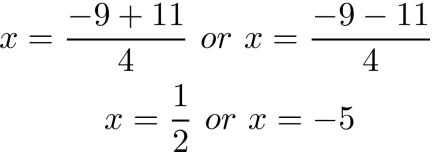
We will now plug in the values and determine x.

1.png

1

Discriminant 

The discriminant of a quadratic equation is used to determine the type if the answer you would get if you solve the equation. THere are three types of answers that you can get when solving a quadratic equation.

  • Two real solutions-This happens when the discriminant results are positive.
  • One real solution-Happens when the discriminant results are zero
  • Two complex-Happens when the discriminant is negative

A complex solution involves the use of an imaginary number. This happens when the square root number is negative, which is technically impossible. To deal with this in math the letter i is used instead of the negative sign below is an example.

1

The actual formula for calculating the discriminant is already in the quadratic formula. You simply calculate only the information under the square root. This is shown below.

1

IN our first example, we got two real solutions. We will now confirm this by calculating the discriminant.

1.png

Are answer is positive, which means that we can expect to calculate to real solutions for this particular problem.

Conclusion

The quadratic formula provides another way to solve a quadratic equation. This is probably the easiest method to learn as it is simply a matter of plugging numbers into the formula. This may explain why the quadratic formula is frequently the first method algebra students learn for solving quadratic equations.

The discriminant is a shortcut calculation that allows you to determine the quality of the solutions you would get if you solve the equation.

Education in Ancient Athens

In many ways, Athens is the home of Western thinking. Countless philosophers were either from Athens or at least spent time there. In this post, we will take a look at education in Ancient Athens.

Background

Athens is located in Central Greece and during antiquity had a population of about 500,000 with about 80% of this population being slaves. This huge disparity between freemen and slaves makes it more amazing that a population of only 100,000 could contribute so much to history.

Generally, slaves and women were not educated. It was considered embarrassing for women to obtain an education. It was the father’s responsibility to educate his son for usefulness.  Failure to do so meant the father forfeited whatever support his son would give him in old age.

The government was shaped largely by Solon. As a democracy, Greece was revolutionary for its time. Solon also established other laws such as outlawing the selling of children and requiring fathers to train their children.

What they Taught

The Athenian education was focused on aesthetics. The idea of beauty influenced everything that was taught.  Subjects taught in Ancient Athens included reading, writing, rhetoric, math, philosophy, music, and poetry. Music and poetry often worked together as poems were set to music. Music was viewed positively as a hobby but professional musicians were looked down on as common laborers.

Physical education was also rigorously taught as beauty was so important. Subjects include swimming, wrestling, running, jumping. One field of study that was often neglected was moral training. The Greek gods were not the best role models.

In place of morals, Greek boys were taught to be patriotic, respect religious rights, and generally to always strive to maintain a good appearance in public.

The teaching methods involved primarily transmission approaches. The teacher would read or say something and the student wrote it down. This was how most subjects were taught.

How they Organized Education

There were essential four levels of education in Ancient Greece. From 0-6 years of age, a boy was under domestic training under his mother or a nanny. Nannys were for the rich.

From 7-14 years of age, the boy was placed under a guardian called a pedagogue and sent to school. There he studied with private teachers the basics of education.

From 14-18 there was a split, the rich continue their education while the poor would branch off and focus on learning a trade from their fathers. For the rich, they would study more complex subjects such as philosophy or higher match. At 18 years of age, a boy would enter military service.

Conclusion

The education found in Ancient Athens was unique in its focus on aesthetics. However, there was at times an indifference to substance and there was almost no interest in moral development. However, educational systems have their flaws and even Ancient Athens is without exception in this regard.

Quadratic Equations and the Square Root Property

A quadratic equation is an equation that includes a variable raised to the second power. Below is a common format for a quadratic equation.

1

This characteristic makes it difficult to rely on linear equation tricks of addition, subtraction, and multiplying to isolate the variable. One trick that we often have to use now is factoring as shown below.

1.png

An alternative way to solve quadratic functions is through having knowledge of the square root property which is shown below.

1

Below is the same example as our first example but this time we use the square root property.

1

This trick works for numbers that cannot be factored.

1

This leads us to the point that the square root property is used for speed or when factoring is not an option.

With this knowledge, all the other possible ways to solve a linear equation can be used to solve a quadratic equation

Division

In the example below is a quadratic formula in which you have to divide to isolate the variable. From there you solve like always1.pngFraction

To remove a fraction you must multiply both sides by the reciprocal as shown below.

1.png

When we got the square root of 18 we had to further simplify the radical by finding the factors of 18. In the second to last line if you multiply these numbers together you will get 18 because  9 * 2 = 18. Furthermore, if you square root 9 you get 3 but you cannot square root 2 and get a whole number. This is why the final answer is 3 * the square root of 2.

Conclusion


Quadratic formulas are common in algebra and as such there are many different ways to solve them. In this post, we looked at an alternative to factoring called the square root property. Understanding this approach is valuable as you can often solve quadratic equations faster and or they can be used when factoring is not possible.

The Life of Pythagoras


Pythagoras was a highly influential educator during the time of ancient Greece. In this post, we will take a brief look at his life and impact on education.

Early Life

Pythagoras was born around 570 BC on the island of Samos. His early life was spent in private study. However, as a young man, Pythagoras traveled to Egypt to acquire additional education.

Down To Egypt

While in Egypt, Pythagoras studied with the Egyptian priest. The Egyptian priest were the masters of education in Egypt and were the only class in Egypt that received an advanced education. Under their tutelage, Pythagoras was exposed to various math and science subjects as well as some of the religious practices of Egypt. He was particularly touched by their way of life and it led him to develop his own style of living that would eventually be called Pythagoreanism.

After completing additional studies in Egpyt, Pythagoras moved to Italy and founded his own school. The school had essentially two levels which were the exoteric and esoteric. Students began in the exoteric studies and stayed there for at least 3 years. After completing exoteric studies a student would begin esoteric studies with Pythagoras himself.

In Italy

The subjects taught at Pythagoras’ school include physics, geography, medicine, math, and even metaphysics. In terms of math, it was Pythagoras who gave algebra students the Pythagorean theorem which states that the square of a  hypotenuse of a right triangle is equal to the sum of the square of the base and the square of the height as shown in the expression below

 base2 + height2 = hypotenuse2

Pythagoras also had distinct metaphysical views. He believed in one truth which was a form of monotheism. This was in stark contrast to the commonly held beliefs of Greece at the time. This could have made him unpopular in a world of polytheism

Pythagoras also believed in the transmigration of the soul. This essentially means that when an animal died they would come back as a lower animal. This is in many ways a form of reincarnation. It was simply another way of saying “You shall not really die” which was an idea shared in a garden by a snake to a woman.

Pythagoras’ school was known for being authoritative and strict, and it even had a habit of being aristocratic. This along with other ideas made Pythagoras school unpopular. So unpopular that a mob would eventually burn his school down to the ground.

Conclusion

It is not clear if Pythagoras died in the flames or lived on as scholars are still debating this. What can be seen is that Pythagoras view of education has continued to live on to this day. His way of life had an influence on many people and his contribution to mathematics has touched the life of practically every algebra student on the planet.

Education in Ancient Sparta

With Ancient Greece there was a small city-state called Sparta. MAny today know of Sparta because of the movies that have been made of this war-like people. Spartan education was primarily a one about military training.

The reason for this emphasis on developing soldiers was due in part to the context in which the Spartans lived. In their own country, they were a minority with a large population of neighboring freeman and an even larger population of slaves. The only way in the Spartans minds to maintain power was through the use of strength. As such this was the focus of their education.

Background

The founder of the government of what makes up classical Sparta was Lycurgus. After spending time in Egypt Lycurgus came to Sparta and developed their constitution. Some of the practices he made lawe included the making all money out of iron to discourage greed and to require men to live in barracks together to encourage unity towards the military and state over the family.

By discouraging greed and familial affections Spartan men were focused on developing strength and military prowess almost to the exclusion of anything else. What else is there for a man to do when he cannot acquire wealth or enjoy his family?

One last point to mention is that children were seen as the property of the state. In a rather cruel way, weak children were eliminated at birth and only the strong were allowed to live. This further strengthens the idea of the state over family.

What They Learned

The training was primarily physical in nature. Young boys were taken from their homes at the age of 7 to live in the state barracks. Once there, they were given a minimum amount of clothes and food. The cold and hunger often compelled the boys to steal. Stealing was actually encourage as it taught stealth. However, being caught was punished severely because it indicated carelessness, which could prove deadly on the battlefield.

Gymnastics, wrestling, and the use of weapons were also emphasized. Despite the contradiction in encouraging stealing the Spartan education also strongly inculcated moral training as well. Boys were to control their appetites, respect the aged as well as their parents, and to be indifferent to suffering. It was considered shameful to lose control of one’s behavior in any way. This naturally discourages such behaviors as drunkness.

Unlike other ancient cultures, the Spartans loved music and spent a large of amount of free time developing this skill. Songs were frequently about war and brave acts.

Women also received an education and the focus was on the development of the physical nature.

How Were They Taught

Spartan boys were taught primarily by the senior citizens or the aged of the society. The old would spend time with the young boys. The common forms of instruction involved a question and answer format. This instilled a great deal of practical wisdom in the youth.

Another primary method of learning was imitation. Young people would learn simply through copying the actions and behaviors of the aged. This imitation of the aged rather than of other young people help Spartans to mature and develop a seriousness to them that would be hard to find in young people today.

COnclusion

The Spartans were a military culture with a strong state apparatus. Their educational system was developed to suppress the people around them in an attempt to maintain their own safety. This desire to survive contributed to a highly oppressive system from the viewpoint of an outsider but perhaps a saving grace for the Spartan.

Solving Single Radical Equations

This post will look at how to solve radical equations. The concepts are mostly similar to solving any other equation in terms of isolating terms etc. However, for people who are new to this, it may still be confusing. Therefore, we will go through several examples.

Example 1

Our first example is a basic radical equation that includes a constant outside the radical. Below is the equation.

1

Solving this problem requires to main steps.

  1. Isolate the radical
  2. Remove the radical by squaring it

Doing these two steps will lead to our answer. We will have two answers but the reason for this will become clear as we solve the equation.

First, we will isolate the radical by subtracting 1 from both sides

1

Now, to remove the radical we will square both sides. This new equation will need to be simplified and will become a quadratic equation.

1.png

With our new quadratic equation we will factor this and as expected get two answers.

1.png

Index Other than 2

For a radical that has an index other than  2, the process involves raising the radical to whatever power will cancel out the radical. Below is an example that has an index of 3. We will first subtract the constant from both sides.

1

In order to remove the index of 3, we need to raise each side of the equation to the power of 3. After doing this, we solve a simple equation.

1

Radicals as Fractions

One a number is a raised to a power that is a fraction it is the same as a radical. Below is an example.

1

This means that the steps we took to solve equations with radicals can be mostly used to deal with equations with powers that are a fraction.

below is an equation. To solve this equation you must raise each side of the equation to the power of the denominator in the fraction.

1.png

As you can see both sides were raised to the 4th power because that is the number in the denominator of the fraction. On the left side of the equation, the 4th power cancels out the fraction. Now you can simply solve the equation like any other equation.

1

Hopefully, this is clear.

Conclusion

Solving radical equatons in not that diffcult. Usually, the ultimate goal is to remove the radical. The difference between this and solving for other equations is that with radical equations you want to first isolate the radical, remove the radical, and then solve for the unknown variable.

Education in Ancient Egypt

Ancient Egypt is perhaps one of the oldest if not the oldest civilization on the planet. With a rich history dating several thousand years Egypt also had a reputation for education as well. This post will discuss education in Egypt with a focus on training by caste.

Background

Egypt was famous for their wisdom and architectural work. In terms of architecture, we are probably all familiar with the pyramids that are still standing after several thousand years. In terms of wisdom, Egypt was so highly regarded in the past that the Greeks sent several future philosophers and leaders to Egypt to study. Among those who went include Plato perhaps the greatest philosopher of all time, Lycurgus, the founder of Sparta, and Solon, the famous Athenian Statesman.

Egypt also had a strong caste system similar to India’s. There were essentially three classes. At the top were the priests, second, was the military, and the lowest classes was everybody else. The lowest class was also sub-divided into three subclasses of farmers/boatmen, then mechanics and tradesman, and lastly the herdsman, fishermen, and laborers. A person was born into their class and it was almost impossible to move from one to the other.

The priestly class was also exempt from taxes and owned as much as 1/3 of the land in Egypt. Their skills and training also commanded high salaries. Egypt was essentially a priests’ country in terms of status and privileges.

What They Study

The education an Egyptian received was heavily influenced by the caste they came from. The priest received the most extensive training. They studied philosophy, natural history, medicine, math, history, law, etc. With this training, a person from the priestly caste could be a physician, historian, surveyor, customs inspector, judge, counselor, etc.

Everyone else received a basic education depending on their occupation. Merchants learned how to read, write, and perform simple math. Tradesman only learned their trade from their parents.

The writing was also divided along class lines. THere were two types of writing systems. The Demotic style was for the masses while the Hieratic style was for the priestly class. The main difference between these two styles is the proportion of hieroglyphics used.

Two subjects commonly ignored in Egyptian education was gymnastics and music. Gymnastics was considered dangerous due to the risk of bodily harm. Music was considered to have an effminate influence on a man if studied to excess.

Conclusion

Ancient Egyptian was unique in terms of the dominance of the priestly class. The priest was allowed to study extensively while everyone else did not seem to enjoy the same access to education. This allowed the priest to wield tremendous informal power within Egypt and to quietly work behind the scenes to achieve goals

Roots, Radicands, and Radicals

Roots, radicands, and radicals are yet another way to express numbers in algebra. In this post, we will go over some basic terms to know.

Roots

A square root is a number that is multiplied by itself to get a new number. Below is an example

1

In the example above 5 is the square root of 25. This means that if you multiply 5 by its self you would get 25.

Another term to know is the square. The square is the result of multiplying a number by its self. In the expression above 25 is the square of 5 because you get 25 by multiplying 5 by its self.

Square Roots

Square roots, in particular, have a lot of other ways to be expressed. To understand square roots you need to know what roots, radicands, and radical sign are. Below is a picture of these three parts.

1

The radical sign is simply a sign like multiplication and division are. The radicand is the number you want to simplify by finding a number that when multiplied by itself would equal the value in the radicand. We also call this new number the square root. For example,

1

What the example above means is that the number you can multiply by itself to get 100 is 10.

The index is trickier to understand. It tells you how many times to multiply the number by its self to get the radicand. If no number is there you assume the index is 2. Below is an expression with an index that is not 2.

1

What this expression is saying is that you can multiply 2 by its self 3 times to get eight as you can see below.

2 * 2  = 4 * 2 =  8

Additional Terms

There are some basic terms that are needed to understand using radicals. Generally, when every we are speaking of multiplying two times we call it square. Multiplying three times is referred to as cub or cubic. Anything beo=yond 3 is called to the nth powered. For example, multiplying a number by its self 4 times would be called to the 4th power, 5 times to the 5th power etc. However, some people referred to the square as the 2nd  power and the cube as the 3rd power if this is not already confusing. Below is a table that clarifies things

Number Power Example
2 square n2
3 cube n3
4 4th power n4
5 5th power n5

Conclusion

There are many more complex ideas and operations that can be performed with radicands and radicals. One of the primary benefits is that you can avoid dealing with decimals for many calculations when you understand how to manipulates these terms. As such, there actual are some benefits in understanding radicands and radicals use.

Education in Ancient China

As one of the oldest civilizations in the world, China has a rich past when it comes to education. This post will explore education in Ancient China by providing a brief overview of it. The following topics

  1. Background
  2. What was Taught
  3. How was it Taught
  4. The Organization of what was Taught
  5. The Evidence Students Provided of their Learning

Background

Ancient Chinese education is an interesting contrast. On the one hand, they were major innovators of some of the greatest invention of mankind which includes paper, printing, gunpowder, and the compass. On the other hand, Chinese education in the past was strongly collective in nature with heavy governmental control. There was extreme pressure to conform to ancient customs and independent deviate behavior was looked down upon.  Despite this, there as still innovation.

Most communities had a primary school and most major cities had a college. Completing university study was a great way to achieve a government position in ancient China.

What Did they Teach

Ancient Chinese education focused almost exclusively on Chinese Classics. By classics, it is meant the writings of mainly Confucius. Confucius emphasized strict obedience in a hierarchical setting. The order was loosely King, Father, Mother, then the child. Deference to authority was the ultimate duty of everyone. There is little surprise that the government support such an education that demanded obedience to them.

Another aspect of Confucius writings that was stressed was the Five Cardinal Virtues which were charity, justice, righteousness, sincerity, and conformity to tradition. This was the heart of the moral training that young people received. Even leaders needed to demonstrate these traits which limited abuses of power at times.

What China is also famous for in their ancient curriculum is what they did not teach.  Supposedly, they did not cover in great detail geography, history, math, science, or language. The focus was on Confucius apparently almost exclusively.

How Did they Teach

Ancient Chinese education was taught almost exclusively by rote memory. Students were expected to memorized large amounts of information.  This contributed to a focus on the conservation of knowledge rather than the expansion of it. If something new or unusual happened it was difficult to deal with since there was no prior way already developed to address it.

How was Learning Organized

School began at around 6-7 years of age in the local school. After completing studies at the local school. Some students went to the academy for additional studies.  From Academy, some students would go to university with the hopes of completing their studies to obtain a government position.

Generally,  the education was for male students as it was considered shameful to not educate a boy. Girls often did not go to school and often handle traditional roles in the home.

Evidence of Learning

Evidence of learning in the Chinese system was almost strictly through examinations. The examinations were exceedingly demanding and stressful. If a student was able to pass the gauntlet of rot memory exams he would achieve his dream of completing college and joining the prestigious Imperial Academy as a Mandarin.

Conclusion

Education in Ancient China was focused on memorization, tradition,  and examination. Even with this focus, Ancient China developed several inventions that have had a significant influence on the world. Explaining this will only lead to speculation but what can be said is that progress happens whether it is encouraged or not.