
Advertisements
Mixture problem and system of equations


Mixture problem and system of equations
Solving a system of equations with substitution

Using the concept of system of equations in the context of uniform motion problems

Application of solving a system of equations

Solving linear inequalities

Solving double inequalities

Uniform motion equations

Calculating Confidence Intervals for Proportions

Solving mixture problems

Solving linear inequalities in word problems.

Calculating simple interest

Solving Linear equations involving word problems

Calculating standard deviation

Solving a linear equation


Solving a system of non-linear equations means that at least one of the equations is not linear. For example, if one equation has an exponent it may be a parabola or a circle. With this no shape that is not linear it involves slightly different expectations.
Solving a system of non-linear equations is similar to solving a system with linear equations with one difference. The difference is that with nonlinear
For example, if one equation is a circle/parabola and the other is a line there can be 0-2 solutions. If one equation makes a circle and the other makes a parabola there can be up to 4 solutions. Two circles or two parabolas can make a multitude of solutions
The steps for solving a nonlinear system are the same. Therefore, in this post, we will demonstrate how to solve a system of non-linear equations using the substitution and elimination methods.
Substitution
The substitution method is when we plug one equation into the variable of the other equation. Below is our system of equations.

The first thing to notice is that the top equation would make a circle if you graphed it. That is why this is a non-linear system. To solve we take the second equation and substitute it for y. Below we find the values for x

Now we complete the system by finding the values for y.

THerefore are ordered pairs are (0, -3) and (1,0). These are the two points at which the equations intersect if you were to graph them.
Elimination
Elimination involves making the coefficients of one of the variables opposite so that when they are added together they cancel each other out. By removing one variable you can easily solve for the other. Below is the system of equation we want to solve.

The top equation makes a circle while the bottom one makes a parabola. This means that we can have as many as four solutions for this system. To solve this system we will multiply the bottom equation by -1. This will allow us to remove the x variable and then solve for y. Below are the steps.

Now we simply solve for y.

Now we can take these values for y to solve for x.


The order pairs are as follows
Conclusion
From this, you can see that non-linear equations can be solved using the same approaches. Understanding this is key to many other fields of math such as data science and machine learning.

A logarithm is the inverse of exponentiation. Depending on the situation one form is better than the other. This post will explore logarithms in greater detail.
There are times when it is necessary to convert an expression from exponential to logarithmic and vice versa. Below is an example of who the expression is rearranged form logarithm to exponential.

The simplest way to explain I think is as follows
Here is an example using actual numbers
As you can see the exponent 3 and the base 2 are on opposite sides of the equal sign for the logarithmic form but er together for the exponential form.
When the base is e (Euler’s Number) it is known as a natural logarithmic function. e is the base rate growth of a continual process. The application of this is limitless. When the base is ten it is called a common logarithmic function.
Logarithmic Model Example
Below is an example of the application of logarithmic models
Exposure to noise above 120 dB can cause immediate pain and damage long-term exposure can lead to hearing loss. What aris the decimal level of a tv with an intensity of 10^1 watts per square inch.
First, we need the equation for calculating the decibel level.

Now we plug in the information into the word problem for I and solve

Our tv is dangerously loud and should include a warning message. We dropped the negative sign because you cannot have negative decibel level.
Conclusion
Logarithms are another way to express exponential information and vice versa. It is the situation that determines which to use and the process of concert an expression from one to another is rather simple. In terms of solving actual problems, it is a matter of plugging numbers into an equation and allowing the calculator to work that allows you to find the answer.

There are times when we want to understand growth that is not constant. An example of this would be the growth of a virus. As time goes by the virus growth rate increases more and more. Another example would be in the world of finance when we are dealing with interest.
In situations like the ones mentioned above, it is critical to understand the use and application of exponential models. This post will go through examples of the use of exponential models.
Finance Example
One common exponential model in finance is for compounded interest. The equation is as follows…

Below is a simple word problem that calls for this equation
You invest $10,000 in a mutual fund to prepare for retirement. The interest rate is 5% compounded monthly, how much will be in the account when you plan to retire in 25 years.
Below is what we now
Now, we simply plug this information into the equatiom to get the answer.

The answer is shown above. The initial investment would grow to almost $35,000 dollars over 25 years.
Continuous Growth
In some fields, such as the life sciences, you want to now the growth of a virus or bacteria. Unlike in finance where the balance grows several times a year, a bacteria is growing continuously. This leads to a slightly different exponential model as shown below.

e is an irrational number that serves as the base. With this information, we can address the problem below
A student starts their experiment with 10 bacteria. He knows the bacteria grow 100% every hour. He will come back and check in 12 hours. How many bacteria will he find?
Here is what we know
We plug this into the equation to get the answer

As you can see, the growth of the bacteria is almost incomprehensible in such a short time. This is the power of exponential growth.
Conclusion
Exponential models provide another way to find answers to questions people have. Whether the growth is over a certain number of times or continuously the model can be adjusted to deal with either of this situations.
One method for solving quadratic equations is called completing the square. This approach is a little confusing but we will try to work through it together in this post.
What is Completing a Square
Completing the square is used when your quadratic equation is not a perfect square. Below is an example of a perfect square quartic formula =. The first is in the standard quadratic form and the second is after it has been simplified.

However, not all equations are this easy, consider the example below.

There is no quick way to factor this as there is no perfect square. We have to use something called the binomial square pattern.

This is where it gets confusing but essential what the binomial square pattern is saying is that if you want to find the third term (b squared) you must take the second term and multiple it by1/2. We multiplied by 1/2 because this is the reciprocal of multiplying by 2 as shown in the equation. Lastly, we square this value. Below is the application of what we just learned from our problem equation.

By taking the second term, multiplying by 1/2 and squaring it we were able to create the trinomial we needed to create the perfect square. By doing this we also solved for x if this was a full equation.
Examples
When using the completing the square approach with a quadratic formula there are some additional steps. We will work through an example below

We are missing the third term and we need to find this first. Our second term is 8 so we will plug this in to find the third term

We take this number 16 and add it to both sides which is a rule whenever manipulating an equation. Therefore, we get the following.

We can now factor the left side as shown below.

To remove the square we need to square root both sides. In other words, we are employing the use of the square root property.

This leads to our two answers as shown below

There are variations of this but they all involve just moving some numbers around before the steps shown here. As such, there is not much need to discuss them.
Conclusion
Completing the square provides a strategy for dealing with quadratic formulas that do not have a perfect square. Success with this technique requires identifying the terms you know and do not know and taking the appropriate steps to calculate the third term for the trinomial.

The quadratic formula is used for solving quadratic equations. The actual creation of this formula is somewhat complex. Creating it requires the use of completing the square as well as square root property. Below is what the equation looks like.

For our purposes, we will go through an example that solves a quadratic equation using the quadratic formula. In addition, we will also explore the idea of the discriminant as it relates to quadratic formulas.
Example
The mechanics of solving a quadratic formula using this approach is similar to most other methods. You simply plug in the substitutes in the equation to get your actual answer. Below is an example,

We will now plug in the values and determine x.

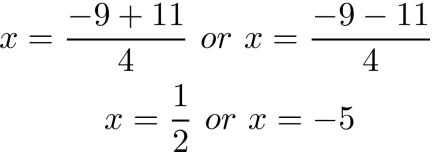
Discriminant
The discriminant of a quadratic equation is used to determine the type if the answer you would get if you solve the equation. THere are three types of answers that you can get when solving a quadratic equation.
A complex solution involves the use of an imaginary number. This happens when the square root number is negative, which is technically impossible. To deal with this in math the letter i is used instead of the negative sign below is an example.

The actual formula for calculating the discriminant is already in the quadratic formula. You simply calculate only the information under the square root. This is shown below.

IN our first example, we got two real solutions. We will now confirm this by calculating the discriminant.

Are answer is positive, which means that we can expect to calculate to real solutions for this particular problem.
Conclusion
The quadratic formula provides another way to solve a quadratic equation. This is probably the easiest method to learn as it is simply a matter of plugging numbers into the formula. This may explain why the quadratic formula is frequently the first method algebra students learn for solving quadratic equations.
The discriminant is a shortcut calculation that allows you to determine the quality of the solutions you would get if you solve the equation.

This characteristic makes it difficult to rely on linear equation tricks of addition, subtraction, and multiplying to isolate the variable. One trick that we often have to use now is factoring as shown below.

An alternative way to solve quadratic functions is through having knowledge of the square root property which is shown below.

Below is the same example as our first example but this time we use the square root property.

This trick works for numbers that cannot be factored.

This leads us to the point that the square root property is used for speed or when factoring is not an option.
With this knowledge, all the other possible ways to solve a linear equation can be used to solve a quadratic equation
Division
In the example below is a quadratic formula in which you have to divide to isolate the variable. From there you solve like always
To remove a fraction you must multiply both sides by the reciprocal as shown below.

When we got the square root of 18 we had to further simplify the radical by finding the factors of 18. In the second to last line if you multiply these numbers together you will get 18 because 9 * 2 = 18. Furthermore, if you square root 9 you get 3 but you cannot square root 2 and get a whole number. This is why the final answer is 3 * the square root of 2.
Conclusion
Quadratic formulas are common in algebra and as such there are many different ways to solve them. In this post, we looked at an alternative to factoring called the square root property. Understanding this approach is valuable as you can often solve quadratic equations faster and or they can be used when factoring is not possible.

This post will look at how to solve radical equations. The concepts are mostly similar to solving any other equation in terms of isolating terms etc. However, for people who are new to this, it may still be confusing. Therefore, we will go through several examples.
Example 1
Our first example is a basic radical equation that includes a constant outside the radical. Below is the equation.

Solving this problem requires to main steps.
Doing these two steps will lead to our answer. We will have two answers but the reason for this will become clear as we solve the equation.
First, we will isolate the radical by subtracting 1 from both sides

Now, to remove the radical we will square both sides. This new equation will need to be simplified and will become a quadratic equation.

With our new quadratic equation we will factor this and as expected get two answers.

Index Other than 2
For a radical that has an index other than 2, the process involves raising the radical to whatever power will cancel out the radical. Below is an example that has an index of 3. We will first subtract the constant from both sides.

In order to remove the index of 3, we need to raise each side of the equation to the power of 3. After doing this, we solve a simple equation.

Radicals as Fractions
One a number is a raised to a power that is a fraction it is the same as a radical. Below is an example.

This means that the steps we took to solve equations with radicals can be mostly used to deal with equations with powers that are a fraction.
below is an equation. To solve this equation you must raise each side of the equation to the power of the denominator in the fraction.

As you can see both sides were raised to the 4th power because that is the number in the denominator of the fraction. On the left side of the equation, the 4th power cancels out the fraction. Now you can simply solve the equation like any other equation.

Hopefully, this is clear.
Conclusion
Solving radical equatons in not that diffcult. Usually, the ultimate goal is to remove the radical. The difference between this and solving for other equations is that with radical equations you want to first isolate the radical, remove the radical, and then solve for the unknown variable.

Roots, radicands, and radicals are yet another way to express numbers in algebra. In this post, we will go over some basic terms to know.
Roots
A square root is a number that is multiplied by itself to get a new number. Below is an example

In the example above 5 is the square root of 25. This means that if you multiply 5 by its self you would get 25.
Another term to know is the square. The square is the result of multiplying a number by its self. In the expression above 25 is the square of 5 because you get 25 by multiplying 5 by its self.
Square Roots
Square roots, in particular, have a lot of other ways to be expressed. To understand square roots you need to know what roots, radicands, and radical sign are. Below is a picture of these three parts.

The radical sign is simply a sign like multiplication and division are. The radicand is the number you want to simplify by finding a number that when multiplied by itself would equal the value in the radicand. We also call this new number the square root. For example,

What the example above means is that the number you can multiply by itself to get 100 is 10.
The index is trickier to understand. It tells you how many times to multiply the number by its self to get the radicand. If no number is there you assume the index is 2. Below is an expression with an index that is not 2.

What this expression is saying is that you can multiply 2 by its self 3 times to get eight as you can see below.
Additional Terms
There are some basic terms that are needed to understand using radicals. Generally, when every we are speaking of multiplying two times we call it square. Multiplying three times is referred to as cub or cubic. Anything beo=yond 3 is called to the nth powered. For example, multiplying a number by its self 4 times would be called to the 4th power, 5 times to the 5th power etc. However, some people referred to the square as the 2nd power and the cube as the 3rd power if this is not already confusing. Below is a table that clarifies things
| Number | Power | Example |
|---|---|---|
| 2 | square | n2 |
| 3 | cube | n3 |
| 4 | 4th power | n4 |
| 5 | 5th power | n5 |
Conclusion
There are many more complex ideas and operations that can be performed with radicands and radicals. One of the primary benefits is that you can avoid dealing with decimals for many calculations when you understand how to manipulates these terms. As such, there actual are some benefits in understanding radicands and radicals use.

Polynomial is an expression that has more than one algebraic term. Below is an example,

Of course, there is much more to polynomials then this simple definition. This post will explain how to deal with polynomials in various situations.
Add & Subtract
To add and subtract polynomials you must combine like terms. Below is an example
All we did was combine the terms that had the y^2 in them. This, of course, applies to subtraction as well.

In the example above, the terms with “a” in them are combined and the terms with “n” in then are combined.
Exponents
When dealing with exponents when multiplication is involved you add the exponents together.

Notice how like terms were dealt with separately.
Since we add exponents during multiplication we subtract them during division.

The 2 in the numerator and denominator cancel out and 7 – 5 = 2.
When parentheses are involved it is a little more complicated. For example, when the exponent is negative you multiply the exponents below

For negative exponents, you fill the numerator and denominator around and make the negative exponent positive.

There are other concepts involving polynomials not covered here. Examples include long division with polynomials and synthetic division. These are fascinating concepts however in the books I have consulted, once these concepts are taught they are never used again in future chapters. Therefore, perhaps they are simply interesting but not commonly used in practice.
Conclusion
Understanding polynomials is critical to future success in algebra. As concepts become more advanced, it will seem as if you are always trying to simplify terms using concepts learned in relation to polynomials.
Cramer’s rule is a method for solving a system of equations using the determinants. In order to do this, you must be familiar with matrices and row operations. Generally, it is really difficult to explain that is a simple matter but there are two main parts to completing this
Part 1:
Part 2:
This is modified if the system is 3 variables. Below we will go through an example with 2 variables.
Example
Here is our problem
Below is the matrix of the system of equations

We will first evaluate the Determinant D using the coefficients. In other words, we are going to calculate the determinant for the first two columns of the matrix. Below is the answer.


What we have just done we will do two more times. Once two find the determinant of x and once to find the determinant of y. When we say determinant x or y we are excluding that column from the 2×2 matrix. In other words, if I want to find the determinant of x I would exclude the x values from the 2×2 matrix when calculating. Below is the determinant of x.


Lastly, here is the determinant of y


We no have all the information we need to solve for x and y. To find the answers we do the following
We know these value already so we plug them in as shown below.

You can plug in these values into the original equation for verification.
The steps we took here can also be applied to a 3 variable system of equation. In such a situation you would solve one additional determinant for z.
Conclusion
Solving a system of equations using Cramer’s rule is much faster and efficient than other methods. It also requires some additional knowledge of rows and matrices but the benefits far outweigh the challenge of learning some basic rules of row operations.

There are several different ways to solve a system of equations. Another common method is Cranmer’s Rule. However, we cannot learn about Cranmer’s rule until we understand determinants.
Determinants are calculated from a square matrix, such as 2×2 or 3×3. In a 2×2 matrix, the determinant is calculating by taking the product of the diagonal and finding the difference.

Here is how this look with real numbers

Determinant for 3×3 Matrix
To find the determinants of a 3×3 matrix it takes more work. By address, it is meant the row number and column letter. To calculate the determinant you must remove the row and column of that contains the variable you want to know the determinant too. Doing this creates what is called the minor. Below is an example with variables.

As you can see, to find the determinant of a1 we remove the row and the column that contains a1. From there, you do the same math as in a 2×2 matrix. When using real numbers you may need to add the row letter and column number to figure out what you are solving for. Below is an example with real numbers.
Find the determinant of c2

The number at c2 is -3. Therefore, we remove the row and the column that contains -3 and we are left with the minor of c2 shown below.

IF we follow the steps for a 2×2 matrix we can calculate the determinant of c2 as follows.
The answer is 4.
Expand by Minors
Knowing the minor is not useful alone, The minor of different columns can be added together to find the determinant for a 3×3 matrix. Below is the expression for finding the determinant of 3×3 matrix.

What is happening here is that you find the determinant of a1 and multiply it by the value in a1. You do this again for b1 and c1. Lastly, you find the sum of this process to evaluate the determinant of the 3×3 matrix. Below is another matrix this time with actual numbers. We are going to expand from the first row and first column

All we do not is obtain the determinant of each 2×2 matrix and multiply it by the outside value before adding it all together. Below is the math.
Conclusion
This information is not as useful on its own as it is as a precursor to something else. The knowledge acquired here for finding determinants provides us with another way to approach a system of equations using matrices.
This post will provide examples of solving a system of equations with 2 variables. The primary objective of using a matrix is to perform enough row operations until you achieve what is called row-echelon form. Row-echelon form is simply having ones all across the diagonal from the top left to the bottom

It is not necessary to have ones in the diagonal it simply preferred when possible. However, you must have the zeros underneath the diagonal in order to solve the system. Every zero represents a variable that was eliminated which helps in solving for the other variables.
Two-Variable System of Equations
Our first system is as follows
Here is our system

Generally, for a 2X3 matrix, you start in the top left corner with the goal of converting this number into a 1.Then move to the second row of the first column and try to make this number a 0. Next, you move to the second column second row and try to make this a 1.
With this knowledge, the first-row operation we will do is flip the 2nd and 1st row. Doing this will give us a 1 in the upper left spot.

Now we want in the bottom left column where the 3 is currently at. To do this we need to multiply row 1 by -3 and then add row 1 to row 2. This will give us a 0.

We now need to deal with the middle row, bottom number, which is -2. To change this into a 1 we need to multiple rows to by the reciprocal of this which is -1/2.

If you look closely you will see that we have achieved row-echelon form. We have all 1s in the diagonal and only 0s under the diagonal.
Our new system of equations looks like the following
If we substitute -1 for y in our top equation we can solove for x.

We now know that x = 3 and y = -1. This indicates that we have solved our system of equations using matrices and row operations.
Conclusion
Using matrices to solve a system of equations can be cumbersome. However, once this is mastered it can often be faster than other means. In addition, understanding matrices is critical to being able to appreciate complex machine learning algorithms that almost exclusively use matrices.

Matrices are a common tool used in algebra. They provide a way to deal with equations that have commonly held variables. In this post, we learn some of the basics of developing matrices.
From Equation to Matrix
Using a matrix involves making sure that the same variables and constants are all in the same column in the matrix. This will allow you to do any elimination or substitution you may want to do in the future. Below is an example


Above we have a system of equations to the left and an augmented matrix to the right. If you look at the first column in the matrix it has the same values as the x variables in the system of equations (2 & 3). This is repeated for the y variable (-1 & 3) and the constant (-3 & 6).
The number of variables that can be included in a matrix is unlimited. Generally, when learning algebra, you will commonly see 2 & 3 variable matrices. The example above is a 2 variable matrix below is a three-variable matrix.


If you look closely you can see there is nothing here new except the z variable with its own column in the matrix.
Row Operations
When a system of equations is in an augmented matrix we can perform calculations on the rows to achieve an answer. You can switch the order of rows as in the following.

You can multiply a row by a constant of your choice. Below we multiple all values in row 2 by 2. Notice the notation in the middle as it indicates the action performed.

You can also add rows together. In the example below row 1 and row 2, are summed to create a new row 1.

You can even multiply a row by a constant and then sum it with another row to make a new row. Below we multiply row 2 by 2 and then sum it with row 1 to make a new row 1.

The purpose of row operations is to provide a way to solve a system of equations in a matrix. In addition, writing out the matrices provides a way to track the work that was done. It is easy to get confused even the actual math is simple
Conclusion
System of equations can be difficult to solve. However, the use of matrices can reduce the computational load needed to solve them. You do need to be careful with how you modify the rows and columns and this is where the use of row operations can be beneficial.

Solving a system of equations with a mixture application involves combining two or more quantities. The general setup for the equations is as follows
Quantity * value = total
Example 1: Making Food
John wants to make 20 lbs of granola using nuts and raisins. His budget requires that the granola cost $3.80 per pound. Nuts are $4.50 per pound and raisins are $1.00 per pound. How many pounds of nuts and raisins can he use?
The first thing we need to determine what we know
Below is all of our information in a table
| Pounds * | Price | Total | |
|---|---|---|---|
| Nuts | n | 4.50 | 4.5n |
| Raisins | r | 1 | r |
| Granola | 20 | 3.80 | 3.8(20) = 76 |
What we need to know is how many pounds of nuts and raisins can we use to have the total price per pound be $3.80.
With this information, we can set up our system of equations. We take the pounds column and create the first equation and the total column to create the second equation.

We will use elimination to solve this system. We will multiply the first equation by -1 and combine them. Then we solve for n as in the steps below

We know n = 16 or that we can have 16 pounds of nuts. To determine the amount of raisins we use our first equation in the system.

You can check this yourself if you desire.
Example 2: Interests
Below is an example that involves two loans with different interest rates. Our job will be to determine the principal amount of the loan.
Tom owes $43,080 on two student loans. The bank’s interest rate is 5.25% and the federal loan rate is 2.95%. The total amount of interest he paid last two years was 6678.72. What was the principal for each loan
The first thing we need to determine what we know
Below is all of our information in a table
| Principal * | Rate | Time | Total | |
|---|---|---|---|---|
| Bank | b | 0.0525 | 1 | 0.0525b |
| Federal | f | 0.0295 | 1 | 0.0295f |
| Total | 43080 | 1752.45 |
Below is our system of equation

To solve the system of equations we will use substitution. First, we need to solve for b as shown below

We now substitute and solve

We know the federal loan is $22,141.30 we can use this information to find the bank loan amount using the first equation.

The bank loan was $20,938.70
Conclusion
Hopefully, it is clear by now that solving a system of equations can have real-world significance. Applications of this concept can be useful in the context of business as shown here.
A system of equations can be solved involving three variables. There are several different ways to accomplish this when three variables are involved. In this post, we will focus on the use of the elimination method.
Our initial system of equations is below

The values eq1,eq2 and eq3 just mean equation 1, 2, 3
To solve this system we need to first solve two equations as a system and create a fourth equation we will call eq4. We then take eq1 and eq3 to create a new system of equations that creates eq5.
It is important to note that for the first two two-variable system of equations you create that you eliminate the same variable it both systems. So fare our example when we take equation 1 and 2 to create equation 4 and then take equation 1 and 3 create equation 5 we must solve for y in both situations or else we will have problems. In addition, you must make sure that all three equations appear at least once in the two two-variable systems of equations. For our purpose, we will use eq1 twice and eq2 and eq3 once.
Eq4 and eq5 are used to find the actual values we need for all three variables. This will make more sense as we go through the example. Therefore, we are going to solve first for y for eq1 and eq2.

To eliminate y we need to multiple eq2 by 2 and then combine the equations. Below is the process and the new eq 4

We will come back to eq4. For now, we will create eq 5 by eliminating y from eq1 and eq3.

We are essentially done using equations 1, 2, and 3. They will not reappear until the end. We will now use equations 4 and 5 to find our answers for two of the three variables.
We now will use eq 4 and 5 to eliminate the variable x. Eliminating x will allow us to solve for z. Doing means we will multiply eq4 by -1.

We know z = -3 we can plug this value into either eq4 or 5 to find the answer for x.

Now that we know x and z we can plug the two numbers into one of the three original equations to find the value for y. Notice how the first variable we eliminated becomes the last one we solve for.

We now know all three values which are
(4, -1, -3)
What this means is that if we were to graph this three equations they would intersect at (4, -1, -3). A solving a system of equations is simply telling us where the lines of the equations intersect.
Conclusion
Solving a system of equations involving three variable is an extension of the two variable system that has already been covered. It provides a mathematician with a tool for solving for more unknown variables. There are practical applications of this as we shall see in the future,

distance = rate * time
We will look at the following examples
Objects Moving in the Same Directions
Below is the problem followed by the solution.
Dan leaves home and travels to Springfield at 100 kph. About 30 minutes later Sue leaves the house and also travels the same way to Springfield driving 125 kph. How long will it take Sue to catch Dan?
The easiest way to solve this is to create a table with all of the information we have. The table is below.
| Names | Rate * | Time = | Distance |
|---|---|---|---|
| Dan | 100 | j | 100j |
| Sue | 125 | k | 125k |
We first need to recognize that they will drive the same distance this leads to one of our equations

However, we are not done. We also need to realize that Sue leaves half an hour later, which leads to the second equation

We can now solve our system of equations

We know Dan travels for 2.5 hours before Sue catches him but we need to determine how long Sue drives before she catches Dan. We will take our answer J and plug it into the original equation for k.

It will take Sue 2 hours to catch up with Dan.
Affect of a Headwind/Tailwind
In transportation, it is common for a plan or ship to be able to travel faster with a tailwind or downstream than with a headwind or upstream The example below shows you how to determine the speed needed to travel a certain distance in the same amount of time as well as the speed of the wind/current.
A plane can travel 548 miles in 1.5 hours with a tailwind but only 494 hours when flying into a headwind. Find the speed of the plane and the wind.
We will have two variables because there are two things we want to know
The tailwind makes the plane go faster, therefore, the speed of the plane will be the plane speed + the wind speed
The tailwind slows the plane down. Therefore, the tailwind will be the speed of the plane minus the windspeed.
Below is a table with all of the available information
| Rate * | Time = | Distance | |
|---|---|---|---|
| Tailwind | p + w | 1.5 | 548 |
| Headwind | p – w | 1.5 | 494 |
The initial system of equations is as follows

To solve this system of equations we will use the elimination method as shown below.

The plane travels 347.33 mph. We now take the value of p plug it into one of our equations to find the speed of the wind.

The speed of the wind is 18 mph. We know the plane travels 347 + 18 = 365 mph with a tailwind and 347-18 = 329mph with a headwind.
Conclusion
A system of equations is proven to have a practical application. The assumption of a uniform speed is somewhat unrealistic in most instances. However, this assumption simplifies the calculation and prepares us for more complex models in the future.

In this post, we will look at two simple problems that require us to solve for a system of equations. Recall that a system of equations involves two or more
Direct Translation
Direct translation involves reading a problem and translating it into a system of equations. In order to do this, you must consider the following steps
Example `1
Below is an example followed by a step-by-step breakdown
The sum of two numbers is zero. One number is 18 less than the other. Find the numbers.
Step 1: We want to know what the two numbers are
Step 2: n = first number & m = second number
Step 3: Set up system

Solving this is simple we know n = m – 18 so we plug this into the first equation n + m = 0 and solve for m.

Now that we now m we can solve for n in the second equation

The answer is m = 9 and n = -9. If you add these together they would come to zero and meet the criteria for the problem.
Example 2
Below is a second example involving a decision for salary options.
Dan has been offered two options for his salary as a salesman. Option A would pay him $50,000 plus $30 for each sale he closes. Option B would pay him $35,000 plus $80 for each sale he closes. How many sales before the salaries are equal
Step 1: We want to know when the salaries are equal based on sales
Step 2: d = Dan’s salary & s = number of sales
Step 3: Set up system

To solve this problem we can simply substitute d for one of the salaries as shown below

You can check to see if this answer is correct yourself. In order for the two salaries to equal each other Dan would need to sale 300 units. After 300 units option B is more lucrative. Deciding which salary option to take would probably depend on how many sales Dan expects to make in a year.
Conclusion
Algebraic concepts can move beyond theoretical ideas and rearrange numbers to practical applications. This post showed how even something as obscure as a system of equations can actually be used to make financial decisions.

A system of equations involves trying to solve for more than one variable. What this means is that a system of equations helps you to see how to different equations relate or where they intersect if you were to graph them.
There are several different ways to solve a system of equations. In this post, we will solve y using the substitution and the elimination methods.
Substitution
Substitution involves choosing one of the two equations and solving for one variable. Once this is done we substitute the expression into the equation for which we did not solve a variable for. When this is done the second equation only has one unknown variable and this is basic algebra to solve.
The explanation above is abstract so here is a mathematical example

We are not done. We now need to use are x value to find our y value. We will use the first equation and replace x to find y.

This means that our ordered pair is (4, -1) and this is the solution to the system. You can check this answer by plugging both numbers into the x and y variable in both equations.
Elimination
Elimination begins with two equations and two variables but eliminates one variable to have one equation with one variable. This is done through the use of the addition property of equality which states when you add the same quantity to both sides of an equation you still have equality. For example 2+2 = 2 and if at 5 to both sides I get 7 + 7 = 7. The equality remains.
Therefore, we can change one equation using the addition property of equality until one of the variables has the same absolute value for both equations. Then we add across to eliminate one of the variables. If one variable is positive in one equation and negative in the other and has the same absolute value they will eliminate each other. Below is an example using the same system of equations as the previous example.
.
You can take the x value and plug it into y. We already know y =1 from the previous example so we will skip this.
There are also times when you need to multiply both equations by a constant so that you can eliminate one of the variables

We now replace x with 0 in the second equation

Our ordered pair is (0, -3) which also means this is where the two lines intersect if they were graphed.
Conclusion
Solving a system of equations allows you to handle two variables (or more) simultaneously. In terms of what method to use it really boils down to personal choice as all methods should work. Generally, the best method is the one with the least amount of calculation.

| Student Name (x values) | ID Number (y values) |
|---|---|
| Jill Smith | 12345 |
| Eve Jackson | 54321 |
| John Doe | 24681 |
Table 1
Two other pieces of information to know are domain and range. The domain represents all x values. In our table above the student names are the x values (Jill Smith, Eve Jackson, John Doe). The range is all of the y-values, THese are represented by ID number in the table above (12345, 54321, 24681).
The table above is nice and neat. However, sometimes the information is not organized into neat rows but is scrambled with the names and ID numbers not lining up. Below is the same information as the table 1 but the ID numbers are scrambled. The arrows tell who the ID number belongs to who. This is known as mapping.
| Student Name | ID Number |
|---|---|
| Jill Smith ↘ | 24681 |
| Eve Jackson→ | 54321 |
| John Doe↗ | 12345 |
If we find the ordered pair, domain and range it would be as follows.
Understanding Functions
A function is a specific type of relation. What a function does is assigns to each element in a domain. Below is an example of a function
Functions are frequently written to look the same as an equation as shown below
PLugging in different values of x in your function will provide you with a y as shown below

Here our x-value is 2 and the y-value is 11.
Of course, you can graph function as any other linear equation. Below is a visual.

Conclusion
This post explained the power of relations and functions. Relations are critical in computer science in particular relational databases. In addition., Functions are a bedrock in statistics and other forms of math. Therefore it is critical to understand these basic concepts of algebra.
The absolute value of a number is its distance from 0. For example, 5 and -5 both have an absolute value of 5 because both are 5 units from 0. The symbols used for absolute value are | | with a number or variable placed inside the vertical bars. With this knowledge lets look at an example of an absolute value.

The answer is +5 because both 5 and -5 are 5 units from 0.
In this post, we will look at equations and inequalities that use absolute values.
Solving one Absolute Value Equations
It is also possible to have inequalities with absolute values. To solve these you want to isolate the absolute value and solve the positive and also the negative version of the answer. Lastly, you never manipulate anything inside the absolute value brackets. you only manipulate and simplify values outside of the brackets. Below is an example.

As you can see absolute value inequalities involves solving two equations. Below is an example involving multiplication.

Notice again how the values inside the absolute value were never changed. This is important when solving absolute value inequalities.
Solving Two Absolute Values Equations
Solving two absolute values is not that difficult. You simply make one of the absolute values negative for one equation and positive for another. Below is an example.

Absolute Value Inequalities
Absolute value inequalities require a slightly different approach. You can rewrite the inequality in double inequality form and solve appropriately when the inequality is “less than.” Below is an example.

You can see that we put the absolute value in the middle and simply solved for x. you can even write this using interval notation as shown below.

“Greater than” inequalities are solved the same as inequalities with equal signs. You use the “or” concept to solve both inequalities.
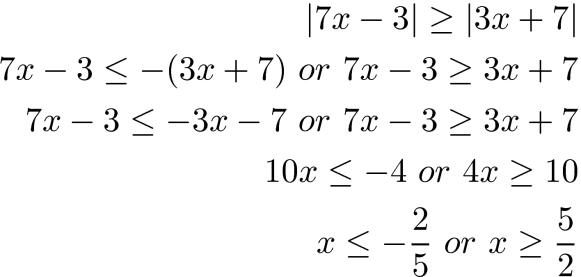
The interval notation is as follows

We use the union sign in the middle is used in place of the word “or”.
Conclusion
This post provided a brief overview of how to deal with absolute values in both equations and inequalities.

Compound inequalities are two inequalities that are joined by the word “and” or the word “or”. Solving a compound inequality means finding all values that make the compound inequality true.
For compound inequalities join ed by the word “and” we look for solutions that are true for both inequalities. Fo compound inequalities joined by the word “or” we look for solutions that work for either inequality.
It is also possible to graph compound inequalities on a number line as well as indicate the final answer using interval notation. Below is a compound inequality with the line graph solution

Solving the answer is the same as a regular equation. Below is the number line for this answer.

The empty circle at -8 means that -8 is not part of the solution. This means all values less than -8 are acceptable answers. This is why the line moves from right to left. All values less than -8 until infinity are acceptable answers. Below is the interval notation.

The parentheses mean that the value next to it is not included as a solution. This corresponds to the empty circle over the -8 in the lin graph. If the value should be included such as with a less/greater than sign you would use a bracket.
Double Inequality
A double inequality is a more concise version of a compound inequality. The goal is to isolate the variable in the middle. Below is an example

This is not complex. We simply isolate x in the middle using appropriate steps. The number line and interval notation or as follows

This time there is a bracket next to -4 which means that -4 is also a potential solution. In addition, notice how the -4 has a filled circle on the number line. This is another indication that -4 is a solution.
Practical Application
You have signed up for internet access through your cell phone. Your bill is a flat $49.00 per month please $0.05 per minute for internet use. How many minutes can you use internet per month if you want to keep your bill somewhere between $54-$74 per month?
Below is the solution using a double inequality
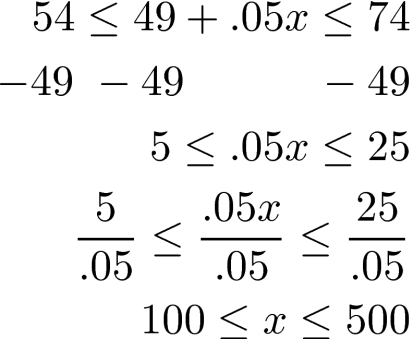
The answer indicates that you can spend anywhere from 100 to 500 minutes on the internet through your phone per month to stay within the budget. You can make the number line and develop the interval notation yourself.
Conclusion
Compound inequalities are useful for not only as an intellectual exercise. They can also be used to determine practical solutions that include more than one specific answer.

Inequalities are equations that use symbols related to less than, greater than, etc. This allows for the solution to be a range of values rather than only one specific one as in many standard equations where you solve for x.
Unique Property of Inequalities
The rules for solving inequalities are mostly the same as for solving a regular equation with one exception. If you multiply or divide both sides of an inequality by a negative number you need to flip the inequality sign. Below is an example of the sign flipping

If you look at the final answer you can see that the x must be greater than -2. This makes sense as -5 * -2 would come to 10 which is not less than 10. Naturally, any number that is larger than -2 would only be worst. Below is a word problem that employs an inequality.
Single Inequality
You have $8,000 to buy math textbooks for your classroom. Each math book cost $127.06. What is the maximum number of math books you can buy?
In the problem above, the keyword is maximum. In other words, there is a range of potential answers from 1 book to whatever the max is. This indicates that this problem is an inequality. Therefore,
Below is the solution to the problem.

You can buy up to 62 books and be less than or equal to 8000. We round down to 62 because we must stay under $8,000 in spending.
Below is another example but slightly more complex as it contains additional information.
Complex Single Inequality
You are planning a three-day camping trip for your students. Currently, there is $420 of money available. The students can earn $22.50 per hour through tutoring. The trip will cost $525 for transportation, $390 for food, and $47.50 per night for the campground. How many hours do the students need to tutor in order to have enough money for the trip?
This problem has three pieces of information on the left of the inequality
The information to the right is the following
We use the less than or equal to inequality <
Below is the solution

The students need to tutor for at least 28hours and 20 minutes in order to meet the expenses for the trip.
Conclusion
Inequalities are another useful tool taught in algebra. The applications are limitless. The key to appreciating inequalities is being able to determine when they can be used to solve real-world problems.

A uniform motion equation involves trying to make calculations when an object(s)
rate * time = distance
Generally, you want to make a table that includes all of the known information. This allows you to determine what the unknown information is that needs to be solved. Below is a table that you can use.
| Rate * | Time = | Distance | |
|---|---|---|---|
Let’s go through some examples
Example 1
Dan and William are riding bicycles. Dan’s speed is 4 kph faster than William’s speed. It takes William 1.5 hours to reach the beach while it takes Dan 1 hour. Find the speed of both bicyclists.
Here is what we know
We will now setup our table
| Rate * | Time = | Distance | |
|---|---|---|---|
| Dan | r + 4 | 1 | 1(r + 4) |
| William | r | 1.5 | 1.5r |
We will now solve this equation by placing Dan’s information on one side of the equation and William’s information on the other side of the equation. Below is the solution

We now know what r is so we need to plug this into the table to get the answers
| Rate * | Time = | Distance | |
|---|---|---|---|
| Dan | 8 + 4 = 12 | 1 | 1(8 + 4) = 12 |
| William | 8 | 1.5 | 1.5(8) = 12 |
The speed of Dan was 12kph while the speed of William was 8kph. This first example was two people traveling the same distance. The next example will be two people travel a different distance.
Example 2
Jenny is traveling to meet her brother. She travels from Saraburi to Chang Mai while her brother travels from Chang Mai to Saraburi. They meet in Bangkok. The distance from Saraburi to Chang Mai is 620km. It takes Jenny 2 hours to get to Bangkok while it takes the brother 7.5 hours to get there. Jenny’s brother’s average speed is 30kph faster than hers. Find the average speed for both people.
The table below captures all of our information
| Rate * | Time = | Distance | |
|---|---|---|---|
| Jenny | r | 2 | 2r |
| Brother | r + 30 | 7.5 | 7.5(r + 30) |
| 620 |
To solve this problem we combine the information about Jenny and her brother and set this information to equal 620 which is the total distance. Below is the solved equation.

We can now place this information in our table.
| Rate * | Time = | Distance | |
|---|---|---|---|
| Jenny | 41.57 | 2 | 2(41.57) = 83.14 |
| Brother | 41.57 + 30 = 71.57 | 7.5 | 7.5(41.57 + 30) = 536.78 |
| 620 |
Jenny average speed was 41.57kph while her brother’s speed was 71.57kph. If you add up the distance traveled it will sum to 620.
Our final example will look at determining the time travel when we know the rate of the two objects.
Example 3
A husband and wife both leave their home. The wife travels east and the husband travels west. Wife travels 80kph while the husband travels 100kph. How long will they travel before they are 360km apart?
Below is what we know
| Rate * | Time = | Distance | |
|---|---|---|---|
| Husband | 100 | t | 100t |
| Wife | 80 | t | 80t |
| 360 |
To solve this we combine the wife and husband information on one side of the equation and put the total distance traveled on the other side. The solution is below.

We place our answer inside our table
| Rate * | Time = | Distance | |
|---|---|---|---|
| Husband | 100 | 2 | 100(2) = 200 |
| Wife | 80 | 2 | 80(2) = 160 |
| 360 |
It takes two hours for the wife and husband to be 360km apart.
Conclusion
Understanding uniform equations involve determining first what you know and then determining what the problem wants you to figure out. If you follow this simple process and are able to identify when an equation involves a uniform application it should not be difficult to find the solution.

There are many examples in the world in which you want to know the quantity of several different items that make up a whole. When such a situation arise it is an example of mixture problem.
In this post, we will look at several examples of mixture problems. First, we need to look at the general equation for a mixture problem.
number * value = total value
The problems we will tackle will all involve some variation of the equation above. Below is our first example
Example 1
There are times when you want to figure out how many coins are needed to equal a certain dollar amount such as in the problem below
Tom has $6.04 of pennies and nickels. The number of nickels is 4 more and 6 times the number of pennies. How many nickels and pennies does Tom have?
To have success with this problem we need to convert the information into a table to see what we know. The table is below.
| Type | Number * | Value = | Total Value |
|---|---|---|---|
| Pennies | x | .01 | .01x |
| Nickels | 6x+4 | .05 | .05(6x+4) |
total 6.04
We can now solve our equation.

We know that there are 18.83 pennies. To determine the number of nickels we put 18.83 into x and get the following.

Almost 117 nickels
You can check if this works for yourself.
Example 2
For those of us who love to cook, mixture equations can be used for this as well below is an example.
Tom is mixing nuts and cranberries to make 20 pounds of trail mix. Nuts cost $8.00 per pound and cranberries cost $3.00 per pound. If Tom wants to his trail mix to cost $5.50 per pound how many pounds of raisins and cranberries should he use?
Our information is in the table below. What is new is subtracting the number of pounds from x. Doing so will help us to determine the number of pounds of cranberries.
| Type | Number of Pounds* | Price Per Pound = | Total Value |
|---|---|---|---|
| nuts | x | 8 | 8x |
| Cranberries | 20-x | 3 | 3(20-x) |
| Trail Mix | 20 | 5.5 | 20(5.50) |
We can now solve our equation with the information in the table above.

Once you solve for x you simply place this value into the equation. When you do this you see that we need ten pounds of nuts and berries to reach our target cost.
Conclusion
This post provided to practical examples of using algebra realistically. It is important to realize that understanding these basics concepts can be useful beyond the classroom.

This post will provide an explanation of how to solve equations that include fractions or decimals. The processes are similar in that both involve determining the least common denominator.
Solving Equations with Fractions
The key step to solving equations with fractions is to make sure that the denominators of all the fractions are the same. This can be done by finding the least common denominator. The least common denominator (LCD) is the smallest multiple of the denominators. For example, if we look at the multiples of 4 and 6 we see the following.

You can see clearly that the number 12 is the first multiple that 4 and 6 have in common. You can find the LCD by making factor trees but that is beyond the scope of this post. The primary reason we would need the LCD is when we are adding fractions in an equation. If we are multiplying we could simply multiply straight across.
Below is an equation that has fractions. We will find the LCD

Here is an explanation of each step
Solving Equations with Decimals
The process for solving equations with decimals is almost the same as for fractions. The LCD of all decimals is 100. Therefore, one common way to deal with decimals is to multiply all decimals by 100 and the continue to solve the equation.
The primary benefit of multiply by 100 is to remove the decimals because sometimes we make mistakes with where to place decimals. Below is an example of an equation with decimals.

Conclusion
Understand the process of solving equations with fractions or decimals is not to complicated. However, this information is much more valuable when dealing with more complex mathematical ideas.

In this post, we will look at several types of equations that you would encounter when learning algebra. Algebra is a foundational subject to know when conducting most quantitative research.
Equations
An equation is a statement that balances two expressions. Often equations include a variable or an unknown value. By solving for the unknown value you are able to balance the equation.
There are many different types of equations such as
(1) Linear equation

(2) Quadratic equation

(3) Polynomial equation
See number 1 or 2. The rule for polynomial equation is that the exponent must be positive
(4) Trigonometric equation

(5) Radical equation

(6) Exponential equation

This post will focus on linear equations.
Linear Equation
A linear equation is an equation that if it is graph will render a straight line. It is common to have to solve for the variable in a linear equation by isolating as in the example below.

There are also several terms related to equations and the include the following

Any value of x will work with an identity equation.

No value of x will work with the equation above.
Conclusion
This post provided an overview of the types of equations commonly encountered in algebra.


